
Health Equity and Racial Justice
Health equity and racial justice are the cornerstone of our public health work in Boston. Learn how we do this work and find tools to create systems change in your organization and community.
Boston is a city rich in health resources. However, not all resources are easily accessible or distributed fairly across all population groups and neighborhoods. This unequal distribution of resources is primarily due to systemic racism, which causes health inequities.
Since the early 2000s, Boston Public Health Commission has partnered with residents, community-based organizations, and other City departments to address these inequities. Our commitment to working in partnership is a continued standard of practice that guides the work we do in the present day.
On June 12, 2020, Boston declared racism a public health crisis. In response, we partnered with residents to learn what a more inclusive Boston free from racism would look and feel like. From their input, we made institutional changes, including developing our Anti-Racism Policy. This policy guides our continued efforts to identify and dismantle systemic racism in polices, practices, and cultural norms.
Through our collaborative partnerships, we have made progress towards advancing health equity in our city. However, we know that there is still more work to be done.
-
-
For more information, contact us below:
-
 1010 Massachusetts Ave.
BOSTON, MA 02118


Our Tools
Our Tools
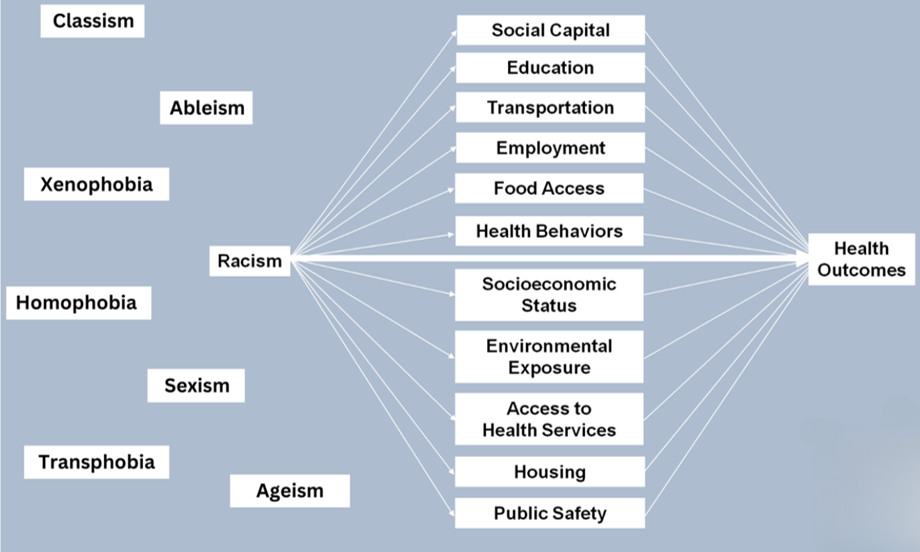
Our health equity framework highlights how racism and other systems of oppression impact the social determinants of health and health outcomes.
We aim to ensure all residents have fair access to conditions that support optimal health, by addressing the factors that shape public health.
CITATION
Boston Public Health Commission, Health Equity Framework (Boston, Massachusetts 2011)
The Health Equity in All Policies approach is a citywide effort to integrate health equity principles into policy decision-making across various City departments, community-based organizations, and within the Boston Public Health Commission. We’re committed to promoting collaboration across different sectors to achieve systems-level change.
We use many tools to support our Health Equity in All Policies approach. These tools equip City leaders and decision-makers to integrate health equity principles into policy decisions.
Core Values
Our core values helps ground our collaborative actions and decision-making processes:
-
Equity
-
Collaboration
-
Anti-Racism
-
Transparency
Transformational Community Engagement Policy
This policy promotes the advancement of racial justice and health equity by sharing decision-making power with communities, ensuring they have a measurable influence on the policies and practices that affect their lives and that lead to sustained systems and structural change.
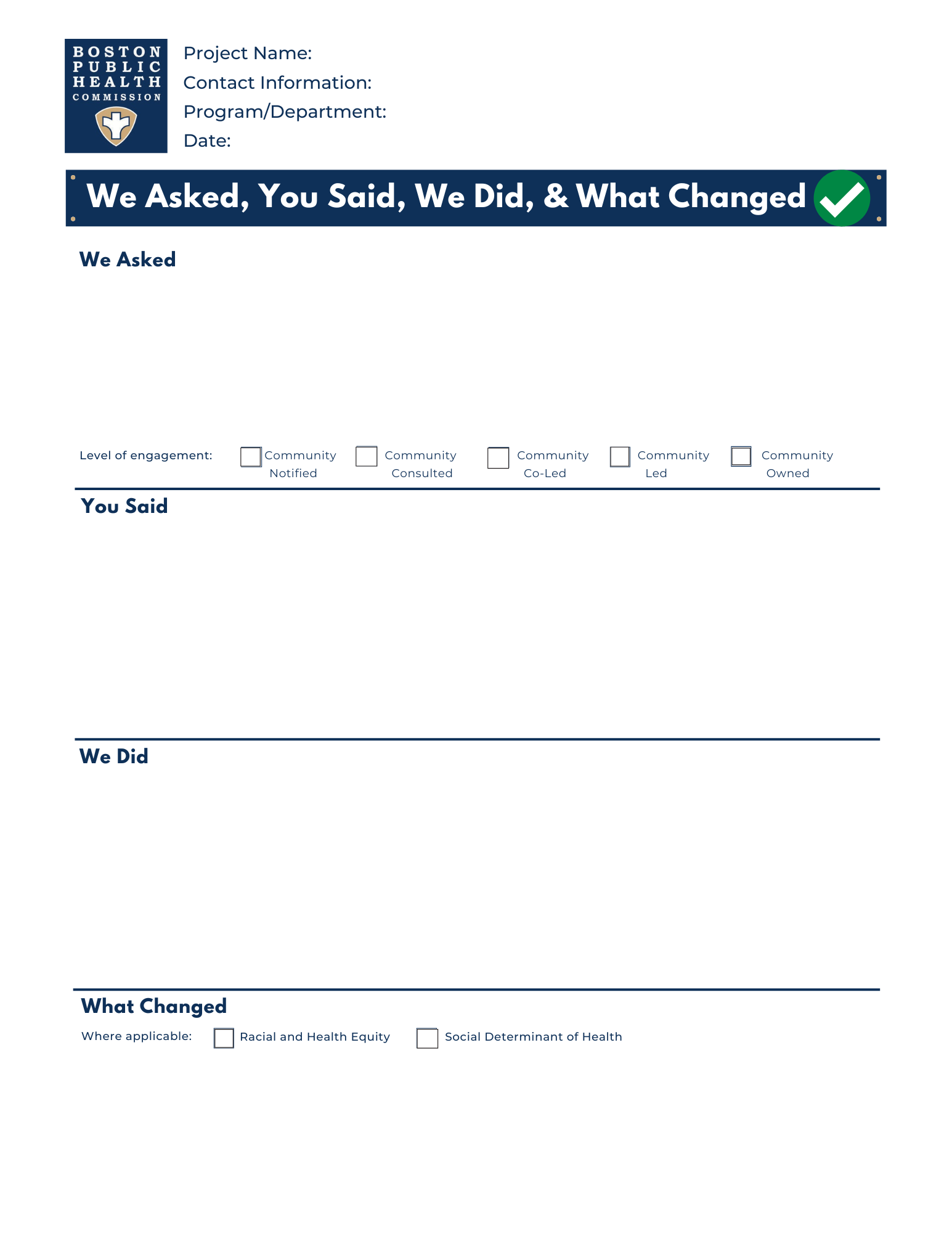
We asked, You Said, We Did, What Changed Model
This model ensures accountability by transparently sharing an overview of the engagement process, including feedback and resulting actions, to demonstrate how community input informs our decision-making.
Equity Lens Assessment
This lens helps decision-makers identify and address the root causes of issues by considering:
-
Alternatives
-
Intended Audience and Engagement
-
Disparities, Inequities, and Social Determinants of Health
-
Intended Impact
-
Unintended Consequences and Mitigation
-
Beneficiaries and Improvements
-
Implementation and Evaluation
CITATION
Boston Public Health Commission, Health Equity in All Policies Approach (Boston, Massachusetts 2024)
The Boston Public Health Commission’s Transformational Community Engagement Policy promotes the advancement of racial justice and health equity by sharing decision-making power with communities, ensuring they have a measurable influence on the policies and practices that affect their lives and that lead to sustained systems and structural change.
Transformational Community Engagement Guidance Toolkit
To access the additional Transformational Community Engagement resources, email healthequity@bphc.org.
Our We Asked, You Said, We Did, What Changed accountability structure is designed to report the impact and outcome of the engagement to collaborative partners and participants of the engagement initiative.
CITATION
Boston Public Health Commission, Transformational Community Engagement (Boston, Massachusetts 2024)
This Equity Lens helps decision-makers identify and address the root causes of issues by considering:
-
Alternatives
-
Intended Audience and Engagement
-
Disparities, Inequities, and Social Determinants of Health
-
Intended Impact
-
Unintended Consequences and Mitigation
-
Beneficiaries and Improvements
-
Implementation and Evaluation
To access the full Equity Lens Assessment, email healthequity@bphc.org.
CITATION
Boston Public Health Commission, Equity Lens Assessment (Boston, Massachusetts 2024)
Our Work in Action
Live Long and Well Agenda
Live Long and Well, Boston's first population health equity agenda, highlights our commitment to closing racial health gaps and improving health outcomes across the city. We do this by focusing on the leading causes of premature mortality in Boston. Live Long and Well also includes commitments to promote physical, mental, and behavioral health across all stages of life for our residents.
Generational Health Scholarship
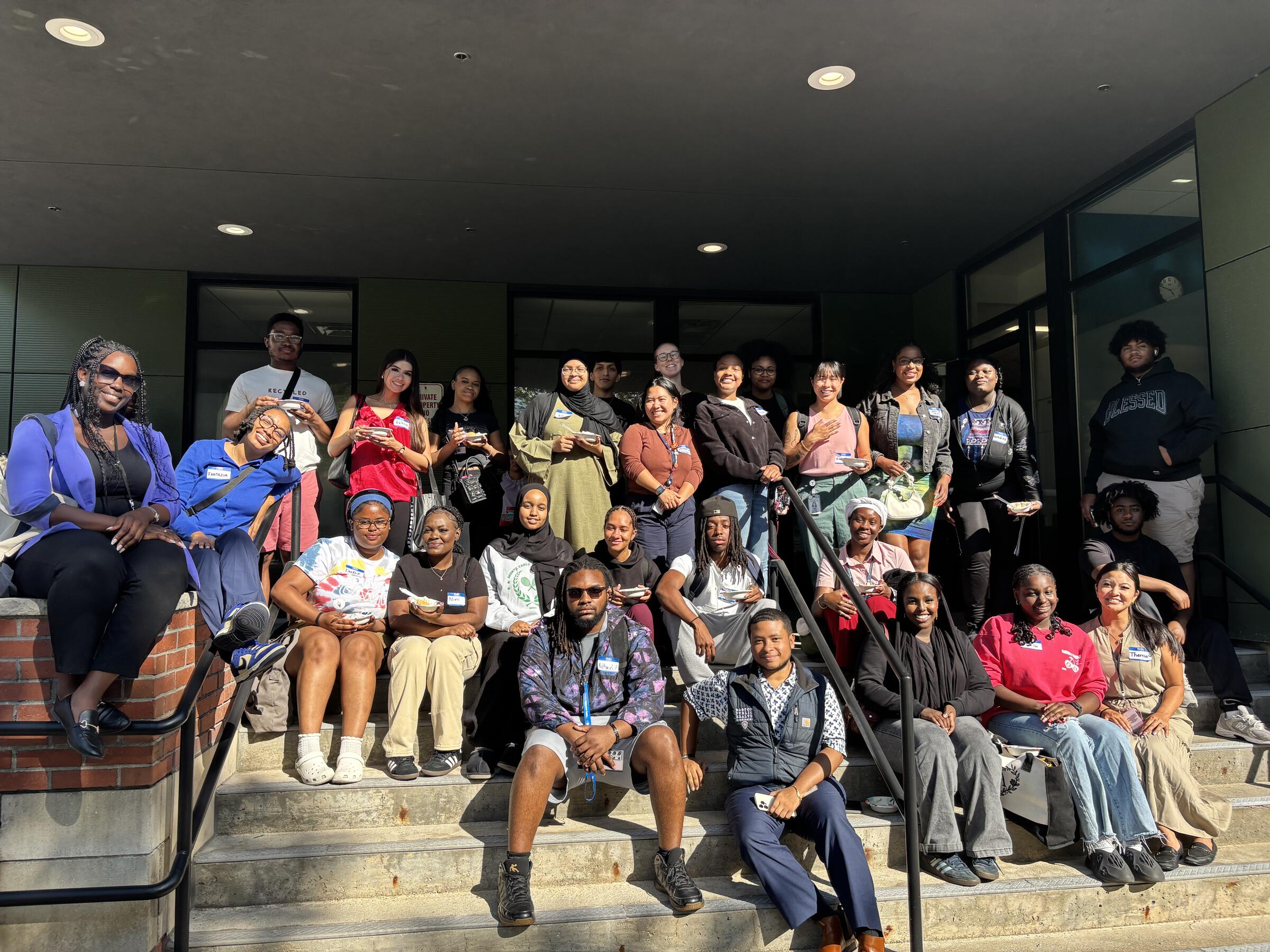
Our Office of Racial Equity and Community Engagement contracted with community-based organizations to administer the Generational Health Scholarship Program. Funded through the Declaration of Racism as Public Health Crisis, this novel need-based scholarship program addresses structural racism’s impact on education by providing monetary support for Boston-area first-year college students who self-identify as Black, Indigenous, Latinx, and/or Native American and who are studying for degrees in STEM, health sciences, public health, and behavioral health.
The City of Boston's Equity and Inclusion Academy
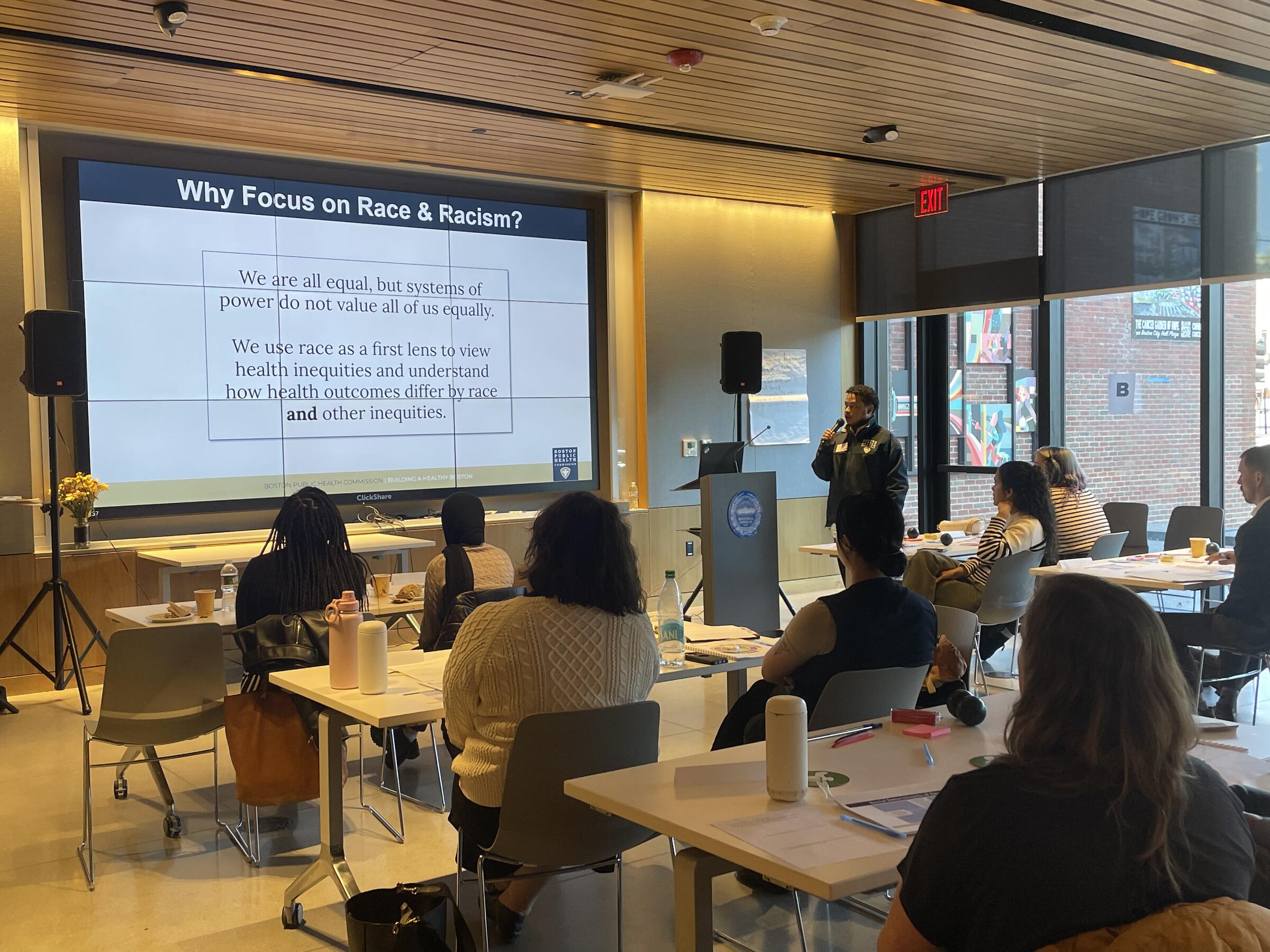
We support the City’s Equity and Inclusion Cabinet's Learning Academy by training City leaders and decision-makers on how to use tools to address the social determinants of health. During trainings, participants are grounded in the understanding of public health and Boston’s journey of racial justice and health equity, and practice using our Equity Lens to examine both positive and negative impacts of all decisions made within their respective departments.
Equitable procurement policY
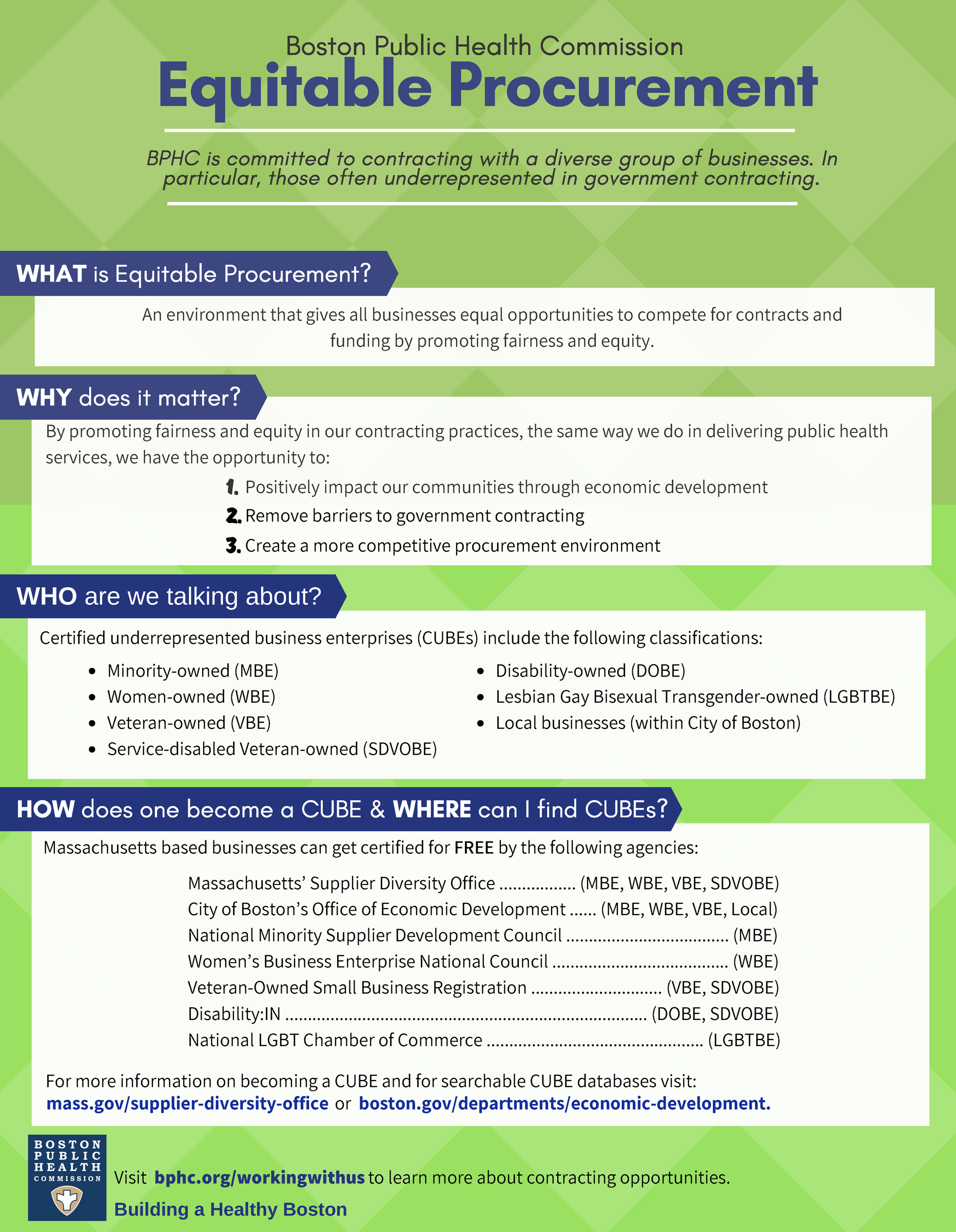
This policy helps create systemic changes by prioritizing certified underrepresented business enterprises. These include businesses owned by:
-
People of color
-
Women
-
LGBTQ+ people
-
Veterans
-
People with disabilities
Data and Reports


Related Resources
Related ResourcesBoston Public Health Commission (BPHC) has been committed to racial justice and health equity in Boston since 2000.
2000:- BPHC, community activists, public health officials, scholars, and other form the REACH Boston 2010 Breast and Cervical Cancer Coalition. The coalition addresses the unequal rates of breast and cervical cancer deaths for Black women.
- BPHC's Anti-Racism Internal Working Group is formed following a Commission-wide "Undoing Racism" Training. The Anti-Racism Advisory Committee (ARAC) is formally established in 2008. Today, ARAC, a volunteer group of BPHC employees, advises and makes recommendations that address systemic and structural racism within the Commission and externally. Read the Mayor's Task Force Blueprint, Disparities Project Data, and the Hospital Working Group Report.
- BPHC Professional Development Series is created. The series help staff apply the principles and practices of health equity and racial justice in their work.
- The Racial Justice and Health Equity Initiative, an organizational change model, is created. Since then, the initiative has evolved into a strategic priority for BPHC.
- The Office of Health Equity (OHE) relaunches. This includes our organizational approach to community engagement.
- OHE launches the first cohort of the Health Equity Advisory Committee.
- The Health Equity in All Policies Initiative is established.
- The Guide to Advance Racial Justice and Health Equity is released.
- BPHC makes Racial Justice and Health Equity its priority in the 2019-2023 Strategic Plan.
- The first Health Equity Champions cohort is formed.
- Racism was declared a Public Health Crisis in the City of Boston.
- The Anti-Racism Policy is released.
- The Office of Health Equity (OHE) title transitioned to the Office of Racial Equity and Community Engagement (ORECE).
- We updated our mission statement to reflect our commitment to combatting racism and systemic inequities.
- Launched Boston's Live Long and Well Agenda, our population health equity agenda, aimed to improve life expectancy and reduce racial and ethnic health disparities.
- We established our Transformational Community Engagement Policy and practices, scaling up from from our previous edition.

About the Office of Racial Equity and Community Engagement
Through visioning, strategy, and relationship building, the Office of Racial Equity and Community Engagement (ORECE) seeks to establish and sustain racial and health equity as core principles in Boston Public Health Commission policies, operations, and decision-making. To actualize the aforementioned purpose statement, ORECE does this by:
- Facilitating the engagement of Boston Public Health Commission colleagues, residents, advisory group members, and community-based organization representatives in public policy, funding and Boston Public Health Commission operational decision-making processes.
- Co-developing, refining, and operationalizing health equity principles including policies, practices, tools, key definitions, frameworks, and training curricula.
- Building City leaders and decision-makers’ muscle to advance racial equity and community engagement through training, technical assistance, and tools.
Who's Involved:

-
-
For more information, contact us below:
-
1010 Massachusetts Ave.
BOSTON, MA 02118
